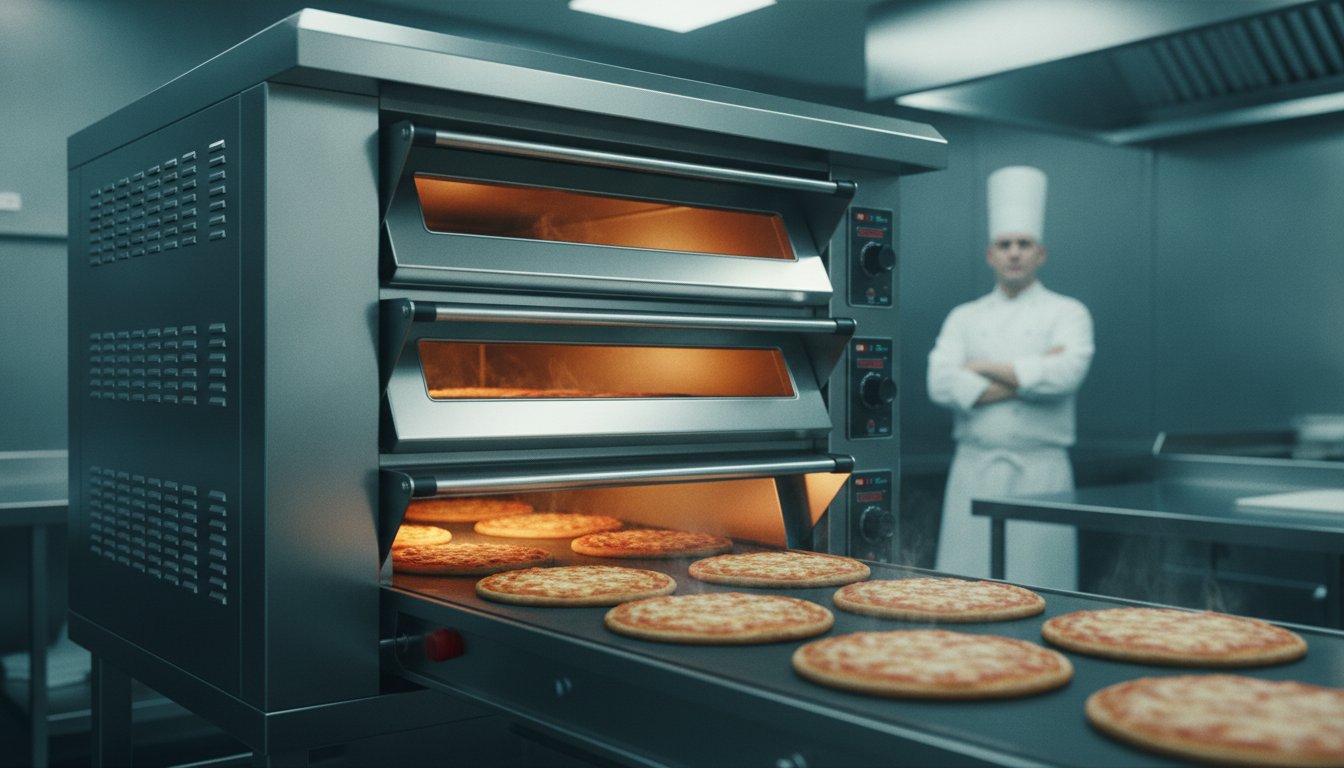
What if your busiest Friday night felt as calm and controlled as a Tuesday afternoon? Scaling your throughput requires more than just a faster pace; it demands a high volume pizza oven designed for precision and reliability. You’ve likely felt the pressure of long ticket times and the worry that comes with inconsistent quality when the dining room is full. It’s a high-stakes environment where your reputation is on the line with every slice. We understand that you want to provide a seamless experience for your guests while keeping operational costs under control.
This guide will help you master the technical requirements for 2026 success, from meeting the latest NSF/ANSI 4-2025 sanitation standards to choosing equipment that reduces labor through smart automation. We’ll walk through the benefits of advanced conveyor ovens and the specific ventilation needs for high-capacity kitchens. By the end, you’ll have the expert knowledge needed to select a durable partner for your kitchen that turns peak hour chaos into a steady, profitable rhythm. Let’s ensure your equipment is as dependable as your hospitality.
Key Takeaways
- Avoid the “peak hour” trap by learning how to size your kitchen for true 100 to 500 pizza per hour demands.
- Discover how air impingement technology from brands like XLT and EDGE creates a consistent bake by stripping away cold air envelopes around your dough.
- Master the “Pizza Per Hour” formula to decide if a single, double, or triple stack high volume pizza oven is the best way to maximize your vertical space.
- Compare the automated speed of conveyor systems against the manual monitoring of deck ovens to choose the right workflow for your staff.
- Learn how a curated approach to equipment selection ensures your kitchen maintains the hospitality and quality your community expects.
Understanding the High-Volume Pizza Oven Challenge
Stepping into a bustling kitchen during the dinner rush feels like conducting an orchestra. To keep the music playing without a hitch, you need equipment that doesn’t just keep up, but leads the way. In our experience, many operators struggle because they haven’t clearly defined what “high volume” means for their specific goals. While a boutique shop might handle 50 pies an hour, a high volume pizza oven is purpose-built for the 100 to 500 range. This jump in scale changes everything from your dough hydration to how you train your seasonal staff.
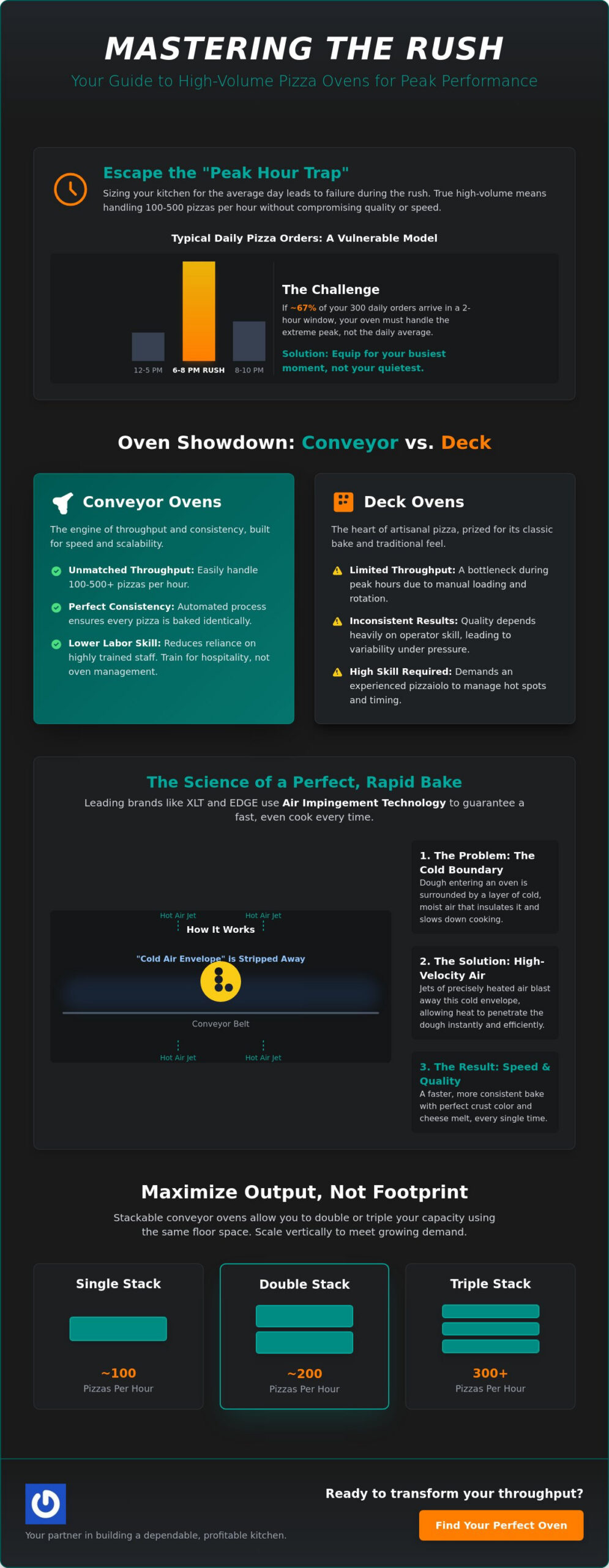
Averages are dangerous in the restaurant business. If you sell 300 pizzas a day, but 200 of those orders flood in between 6:00 PM and 8:00 PM, sizing your kitchen based on a twelve-hour average leaves you vulnerable. This “peak hour trap” leads to backed-up tickets and frustrated guests. You need a solution that handles the maximum possible stress of your busiest Saturday night, ensuring the last pizza of the shift looks exactly like the first.
Consistency serves as your most effective labor-saving tool. By removing the “art” of manual rotation and constant monitoring, you allow your team to focus on prep and hospitality. When you explore the various types of commercial pizza ovens, you’ll see that modern engineering focuses on thermal mass and recovery time. A high volume pizza oven must possess enough “stored” heat to cook cold dough rapidly without the internal temperature plummeting after every launch.
The Impact of Throughput on Restaurant Profitability
When your kitchen falls behind, the costs go beyond just a late meal. Slow ovens lead to lost revenue through delivery app cancellations and negative reviews that linger long after the rush. High-volume throughput is the ability to maintain 95% peak capacity for over four hours. Transitioning from manual deck management to automated conveyors reduces your reliance on highly skilled labor, allowing your business to scale even when the local talent pool is tight. It turns a high-stakes environment into a predictable, manageable process.
Key Performance Indicators for Commercial Ovens
Beyond simple heat, you must look at recovery time. This metric matters far more than maximum temperature because it determines how quickly the oven is ready for the next pizza. We also look closely at BTU ratings versus actual heat transfer efficiency; a higher rating doesn’t always mean a better bake if the heat isn’t reaching the crust effectively. Finally, consider the energy consumption per pizza. In high-capacity operations, these hidden costs can significantly impact your bottom line if your equipment isn’t optimized for 24/7 use.
Conveyor vs. Deck Ovens: Evaluating Throughput and Quality
Choosing between a conveyor and a deck oven often feels like choosing between a high-speed engine and a hand-crafted tool. Deck ovens are beloved for that classic artisanal “char” and the traditional feel they bring to a kitchen. However, they demand constant monitoring and a highly skilled operator to rotate pies and manage hot spots. In a high-capacity environment, this manual “art” can quickly become a bottleneck that slows down your service and stresses your staff. You want your kitchen to run with the grace of a well-oiled machine, even when the orders are piling up.
Conveyor ovens are the undisputed kings of speed and consistency. They remove the guesswork from the baking process, ensuring that every pizza travels through the chamber at a precise speed and temperature. This reliability allows you to hire team members based on their attitude and hospitality rather than their years of experience managing a deck. It’s about building a system that supports your people. When you can trust your equipment to deliver a perfect result every time, you can focus on the neighborly service that defines your brand.
Space is often your most valuable resource. When square footage is tight, a high volume pizza oven that offers stackable configurations allows you to double or triple your output without expanding your footprint. This vertical scaling is essential for growing businesses that need to maximize every inch of their modern restaurant kitchen. If you are ready to see how these systems can transform your workflow, feel free to browse our selection of commercial pizza ovens.
When to Choose a Conveyor Pizza Oven
If your business model leans heavily on delivery or a standardized menu, a conveyor system is your best partner. These machines use air impingement technology to blast away the cold air envelope surrounding the dough, resulting in a significantly faster bake than traditional conduction. This technology ensures that even during a four-hour peak, your ticket times remain predictable. It’s the most reliable way to maintain the steady, confident rhythm your customers expect from a professional establishment.
The Role of Consistent Dough Preparation
Even the most advanced high volume pizza oven will fail to deliver if your prep work is inconsistent. High-volume success starts long before the pizza hits the belt; it begins in the bowl. Uniform dough hydration is critical because variations in moisture will cause uneven browning and texture, even in a perfectly calibrated oven. We recommend integrating Hobart Mixers into your workflow to ensure your dough is identical every single time. This synergy between your prep equipment and your final bake creates the seamless quality that keeps your community coming back for more.
The Science of Air Impingement: Why XLT and EDGE Lead the Market
Air impingement technology is the secret behind the consistent, high-speed performance of a modern high volume pizza oven. Traditional ovens rely on conduction or slow-moving hot air, which often allows a “cold air envelope” to form around your dough. This layer of cool air acts as insulation, slowing down the bake and leading to soggy crusts during a rush. Impingement ovens solve this by using high-velocity jets of hot air to strip away that envelope, delivering heat directly to the pizza for a crisp, even finish in a fraction of the time. It’s a precise, engineered approach to heat transfer that ensures your quality never dips, even when your ticket count peaks.
Precision remains at the heart of this technology. You can adjust the top and bottom heat independently to suit your specific crust, whether you’re serving a delicate thin crust or a hearty deep dish. Beyond the bake, the evolution of these machines has focused on the people using them. Older models were notoriously loud, creating a stressful environment for your kitchen staff. Today’s leading brands have engineered quieter systems that improve the overall kitchen atmosphere, making it easier for your team to communicate and serve with hospitality. This focus on durability ensures your equipment survives the 24/7 operational cycles required by the most successful pizzerias.
XLT Ovens: The Standard for Global Franchises
XLT Ovens have earned their place in the world’s largest pizza delivery chains by prioritizing simplicity and uptime. Their tool-less cleaning design, highlighted in recent models like the J-Version, reduces maintenance costs and ensures your staff spends less time on chores and more time on hospitality. The patented “Quiet Fire” technology significantly lowers ambient noise, creating a more professional atmosphere for your team. When you choose XLT, you’re investing in a partner that understands the high-stakes nature of global throughput. It’s about providing a reliable, neighborly experience for every customer, every time.
EDGE Ovens: Efficiency and Precision Engineering
EDGE Ovens stand out for their advanced modulation burners, which precisely adjust the flame to maintain heat while reducing gas consumption. This efficiency doesn’t come at the cost of versatility. With customizable belt speeds, you can transition from wings and sandwiches to pizzas without missing a beat. Choosing between these top-tier brands requires an insider’s perspective to match your specific menu to the right technology. It’s vital to consult a professional restaurant equipment guide when selecting an EDGE system to ensure it aligns perfectly with your long-term goals.
Calculating Capacity: Scaling Your Kitchen with Stackable Solutions
Understanding the math behind your kitchen’s potential is the first step toward true growth. When you’re looking for a high volume pizza oven, you aren’t just buying a piece of equipment; you’re investing in your future capacity. We use the “Pizza Per Hour” (PPH) formula to help our partners determine exactly how much belt space they need to meet their busiest demands. This calculation considers your average bake time, the diameter of your pies, and how many can sit side-by-side on the conveyor during a rush. It’s about moving from guesswork to a predictable, reliable system.
Stackable solutions are a game-changer for businesses rooted in growing communities where square footage is at a premium. By using vertical space with double or triple stacks, you can increase your output without the costly expense of expanding your kitchen’s footprint. If you’re just starting, we often suggest buying a stackable base now. It’s a smart way to future-proof your business, allowing you to add another deck when your neighborhood’s demand grows. For those with diverse menus, split-belt configurations allow you to run different cook times simultaneously, ensuring wings and sandwiches are finished with the same precision as your pizzas.
Determining Your Required Belt Width
The width of your belt is the primary driver of throughput. While an 18-inch belt is excellent for smaller operations, high-capacity shops usually require more surface area. A 32-inch wide conveyor can typically double the output of an 18-inch model in the same footprint. For example, a 32-inch belt allows you to run two 14-inch or 16-inch pizzas side-by-side, effectively doubling your PPH compared to a narrower machine. Calculating throughput for 12-inch, 14-inch, and 16-inch pizzas ensures you choose a belt that won’t leave your customers waiting when the dining room is full.
Ventilation and Utility Requirements
Your choice between gas and electric models often depends on your existing utility infrastructure and local energy costs. High-BTU gas ovens provide incredible power, but they require robust ventilation systems to operate safely and efficiently. Planning for the commercial kitchen infrastructure needed to support high-BTU loads is essential to avoid delays during installation. Multi-stack configurations will almost certainly require a Type I hood with specific overhang requirements to meet current 2026 safety codes. If you’re ready to map out your kitchen’s potential, we invite you to explore our conveyor oven options and find the perfect fit for your space.
Sourcing Your High-Volume Oven with Southern Select Equipment
When you’re ready to make a significant investment in your kitchen’s future, you deserve more than a cold transaction. Choosing a high volume pizza oven is a high-stakes decision that impacts your staff’s daily rhythm and your guests’ experience. Southern Select Equipment believes in a partnership built on integrity and expert knowledge. Our team works to match your specific menu requirements with the exact impingement technology that will serve your community best. We’ve walked this path with many operators; we understand that reliability is the only metric that matters when the dining room is full and the tickets are hanging low.
The Southern Select Equipment advantage lies in our curated approach to inventory. We don’t just sell equipment; we vet every piece of machinery for the durability required in 24/7 operational cycles. By offering a “Select” range of industry leaders like XLT, EDGE, and Lincoln, we ensure you’re choosing from the very best the market has to offer. This focus on premium quality means your kitchen stays productive and your energy bills remain manageable. Southern Select Equipment provides the steady, confident guidance you need to scale your business with ease.
A truly successful kitchen requires a comprehensive system where every component works in harmony. From the precision of Hobart mixers for your dough prep to the dependable cooling of commercial refrigerators, Southern Select Equipment supports your entire workflow. This holistic view ensures that your new oven isn’t just a standalone tool, but a core part of a seamless production line. We’re committed to your long-term success, providing the professional authority and neighborly care that defines our identity.
Why a “Trusted Local Guide” Approach Matters Nationally
In an industry that often feels impersonal, we bring the warmth of Southern hospitality to every interaction. Southern Select Equipment acts as your trusted local guide, possessing an insider’s knowledge of how equipment performs under the unique pressures of a high-capacity environment. Every oven in our inventory is selected for its ability to survive the rigors of professional use while remaining accessible and easy for your team to operate. It’s about more than just numbers. It’s about the people and the places behind the properties we serve. You aren’t just a client to us; you’re a neighbor we’re helping to succeed.
Beyond the Oven: Building a High-Volume System
Scaling your throughput requires careful planning for your entire equipment lifecycle. High-capacity refrigeration is a necessity for proper dough proofing, ensuring your ingredients are always ready for the heat of the day. Southern Select Equipment helps you navigate these requirements, from initial consultation to long-term support. Our goal is to create a sense of calm and competence in your kitchen, even during the busiest Gulf Coast summers. When you’re ready to take the next step toward 2026 success, we invite you to browse our current inventory of high-volume pizza ovens and discover the difference that expert curation makes.
Future-Proof Your Kitchen for Lasting Success
Success in 2026 is about more than just surviving the evening rush; it’s about leading your community with confidence and consistency. You now understand how the right throughput math and air impingement technology from leaders like XLT and EDGE can transform your daily operations. By focusing on recovery times and stackable solutions, you can turn peak-hour stress into a steady, predictable rhythm that supports your staff and delights your guests. A high volume pizza oven isn’t just a tool; it’s the heartbeat of a growing business that values quality and hospitality in equal measure.
As an authorized dealer for XLT and EDGE, Southern Select Equipment provides the expert guidance you need to choose equipment that stands the test of time. We specialize in both new sales and high-volume restaurant liquidations, ensuring you find the perfect fit for your specific goals. Our deep expertise in Hobart mixer integration ensures your dough is as reliable as your bake, creating a seamless system from prep to plate. When you’re ready to grow, upgrade your kitchen with Southern Select Equipment high-volume ovens and experience the difference of a partner who truly cares about your success. We look forward to helping you build a legacy of excellence.
Frequently Asked Questions
What is the best type of oven for a high-volume pizza shop?
Conveyor ovens are generally the best choice for operations that prioritize speed and consistency. They remove the variables of human error associated with deck ovens, allowing your team to focus on hospitality while the machine handles the precision of the bake. This ensures every guest receives the same high-quality meal, even during the busiest rushes.
How many pizzas can a triple-stack conveyor oven cook per hour?
A triple-stack configuration can typically produce between 150 and 300 pizzas per hour depending on the belt width and your specific bake time. This setup allows you to maximize your vertical space, providing the throughput needed for heavy demand without requiring a larger kitchen footprint. It’s the most reliable way to scale your capacity as your neighborhood grows.
Do conveyor ovens use more gas than deck ovens?
While they may have a higher BTU rating, modern conveyor ovens are often more efficient per pizza because of their high-speed throughput. Advanced modulation burners in brands like EDGE help reduce gas consumption by adjusting the flame to maintain heat only when it’s needed. This precision engineering helps keep your utility bills manageable over long operational cycles.
Can I bake artisanal-style pizza in a high-volume conveyor oven?
Yes, you can achieve a high-quality artisanal result by adjusting the independent top and bottom air impingement settings. While it offers a different experience than a wood-fired hearth, a high volume pizza oven can be calibrated to produce a crisp crust and perfectly melted toppings. This allows you to maintain your signature style while meeting the demands of a high-capacity environment.
What is the difference between an impinger oven and a standard conveyor?
An impinger oven uses high-velocity jets of hot air to strip away the cold air envelope around the dough, whereas a standard conveyor relies on slower radiant heat. This technology results in a bake that is significantly faster and more consistent across every single pie. It’s the standard for serious operators who need to maintain quality at scale.
How much ventilation does a double-stack XLT oven require?
A double-stack XLT oven typically requires a Type I hood with a minimum 6-inch overhang beyond the oven’s edge for proper heat and smoke capture. It’s vital to consult your local building codes, as 2026 regulations often specify exact elevation requirements based on the total BTU output of your equipment. Proper ventilation ensures a comfortable and professional environment for your staff.
Is it better to buy a wider belt or a taller stack for more capacity?
A wider belt is usually better for immediate throughput, while a taller stack offers the best long-term flexibility. A 32-inch belt allows you to run two pizzas side-by-side on a single level, but adding a second or third deck is the most efficient way to scale your high volume pizza oven as your business matures. We often recommend starting with a stackable base to keep your options open.
What maintenance is required for high-volume commercial ovens?
Daily cleaning of the conveyor belt and crumb trays is essential to prevent debris buildup and maintain food safety standards. You should also schedule professional inspections of the blowers and burners every six months to ensure your system complies with the latest NSF/ANSI 4-2025 sanitation requirements. Regular care protects your investment and ensures your kitchen remains a reliable partner for your business.