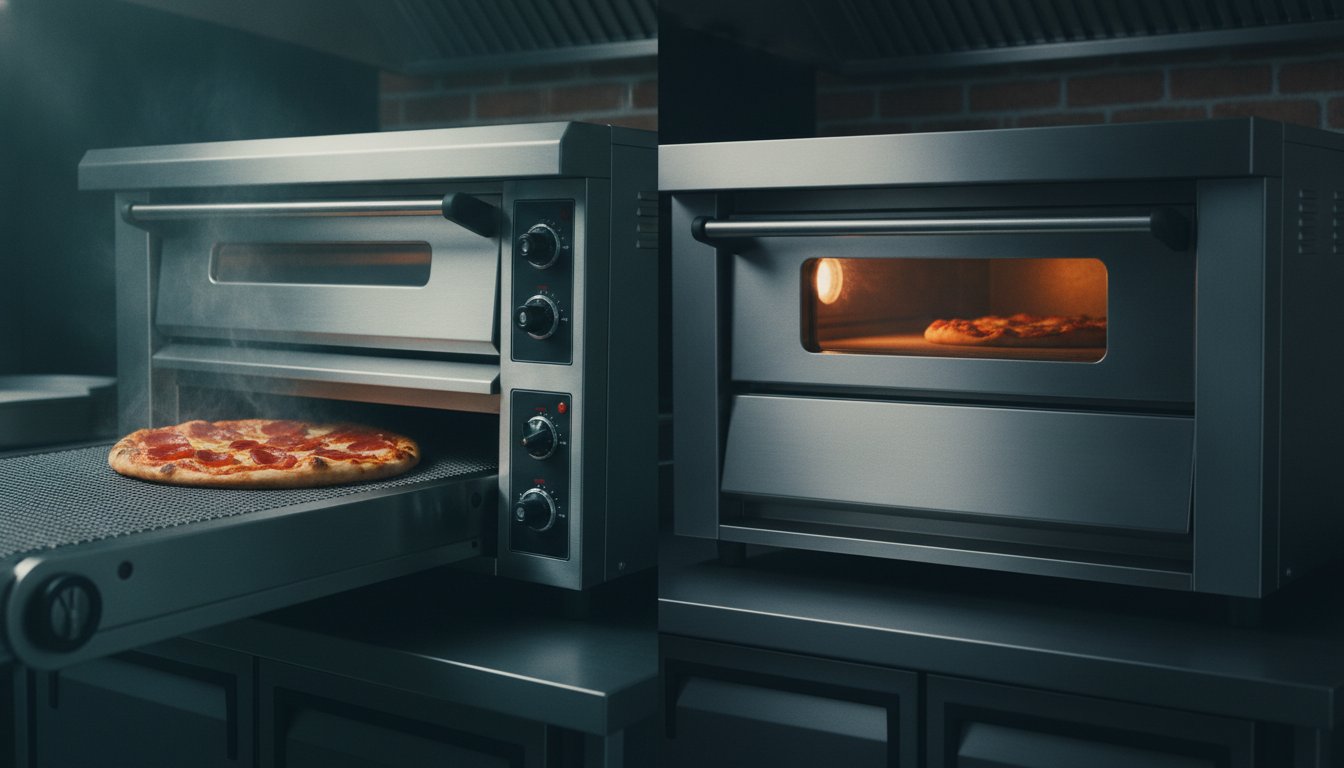
With 96% of restaurant operators reporting a surge in labor costs this year, is your kitchen’s heart actually a drain on your bottom line? It’s a stressful time to run a high-volume pizzeria, especially when over 60% of staff members feel frequently overwhelmed by the peak hour rush. You want to maintain a signature bake quality that keeps your neighbors coming back, but finding a skilled oven tender is becoming a rare luxury. This guide will help you settle the conveyor vs deck pizza oven debate by looking at the hard operational numbers for 2026.
At Southern Select, we believe in providing the expert guidance you need to make a seamless transition to more efficient equipment. We’ll explore how modern automation can solve your staffing hurdles, maximize your pizzas-per-hour, and keep your utility bills manageable. Whether you’re aiming for the artisanal touch of a deck or the high-speed consistency of a conveyor, we’ll help you find the perfect fit for your unique business. This comparison provides a professional roadmap to ensure your kitchen remains both profitable and welcoming, reflecting the true spirit of hospitality.
Key Takeaways
- Understand the fundamental differences between stone-hearth conduction and air impingement technology to ensure your signature bake meets your community’s high standards.
- Compare the labor demands of a conveyor vs deck pizza oven to see how you can maintain consistent quality without the high cost of specialized oven tenders.
- Explore how to increase your kitchen’s throughput using stackable configurations that provide maximum pizzas-per-hour without requiring a larger footprint.
- Gain expert insights into high-performance brands like XLT and EDGE, ensuring your investment provides the long-term reliability your business deserves.
- Learn to calculate a true operational ROI by weighing energy efficiency and reduced training time against your initial equipment purchase.
The Great Pizza Debate: Defining the Conveyor and Deck Oven
Choosing between a conveyor vs deck pizza oven is about more than just picking a piece of kitchen hardware. It’s a decision that defines your brand’s identity, your staff’s daily rhythm, and the final experience you offer your guests. If you look at a technical Pizza oven overview, you’ll see that the fundamental difference lies in how heat is transferred to your dough. In 2026, this choice is more nuanced than ever because the traditional divide between “artisan quality” and “commercial speed” is rapidly narrowing.
Your oven dictates the flow of your entire operation. A deck oven requires a hands-on approach that values the human touch, while a conveyor oven prioritizes a seamless, automated process. As labor costs continue to rise and skilled kitchen staff become harder to find, understanding these two distinct technologies is the first step toward building a sustainable, profitable business.
The Heritage and Appeal of the Deck Oven
The deck oven is the soul of the traditional pizzeria. It relies on conduction; heat is stored in heavy stone or ceramic hearths and transferred directly into the pizza crust. This thermal mass is what creates the “char” and complex crumb structure associated with New York or Neapolitan styles. However, this beauty comes with a high demand for skill. A dedicated “pizzaiolo” must constantly monitor the chamber, rotating pies to avoid hot spots and managing the recovery time of the stone after a heavy rush. It’s a dance of heat and timing that requires weeks, if not months, of training to master. For many, this manual artistry is a core part of their brand’s hospitality and charm.
The Engineering Evolution of Conveyor Ovens
Modern conveyor ovens have moved far beyond the “fast food” reputation of the past. They utilize air impingement technology, which uses high-velocity “fingers” of hot air to strip away the cold boundary layer surrounding the food. This allows for incredibly fast, consistent bake times. The most significant shift we’ve seen in 2026 is the adoption of stone-link belts. By replacing traditional wire mesh with stone-like materials, brands like XLT Pizza Ovens and EDGE Pizza Ovens have bridged the gap, providing that sought-after bottom heat while maintaining the “set-it-and-forget-it” ease of a conveyor. This evolution ensures that even your newest team member can produce a perfect, uniform pizza every single time, which is why top national brands and high-volume local favorites alike are making the switch to ensure brand consistency across every order.
How They Cook: Conduction vs. Air Impingement Technology
When you’re deciding between a conveyor vs deck pizza oven, you’re essentially choosing between two distinct methods of heat transfer: conduction and convection. A deck oven relies on conduction, where heat moves directly from a hot stone hearth into the dough. This creates that classic crisp bottom. This method has its limits, though. During a busy Friday night, every time you slide a cold pizza onto the deck, the stone loses heat. If you don’t give it time to recover, your crust ends up soggy and undercooked. It’s a frustrating inconsistency that can impact your reputation for quality.
Conveyor ovens take a different approach. They use air impingement technology to cook with speed and precision. This method uses high-velocity jets of hot air to strip away the “cold boundary layer” that naturally surrounds a raw pizza. By breaking through this layer of cool air, the oven transfers heat much more efficiently than a standard deck. This is why conveyors can typically cut your cook times by 30 to 50 percent. This speed is a game-changer for high-volume kitchens where every second counts. Finding the right balance for your kitchen is easier with our curated selection of commercial pizza ovens.
A detailed Deck Oven vs. Conveyor Oven analysis shows that while one relies on direct contact, the other uses forced convection to achieve uniformity. Your choice depends on whether you value manual artistry or automated throughput.
The Science of Air Impingement in Brands like XLT
Air impingement is the precision-targeted delivery of heated air to the product surface. In professional XLT Pizza Ovens, this is achieved through adjustable “fingers” located above and below the belt. These fingers allow you to customize the bake profile, ensuring the cheese melts and the toppings brown at the exact same rate the crust crisps. This level of control removes the guesswork from your line. You get a perfect bake every time, regardless of who’s working the kitchen. This consistency is the primary reason high-output pizzerias prefer impingement over traditional radiant heat.
Thermal Stability and Recovery in Professional Deck Ovens
The greatest strength of a deck oven is its thermal mass. The heavy stone decks hold a massive amount of BTU (British Thermal Units), which is vital for that signature “char.” But this mass is also a limitation. Once those decks lose their heat during a heavy rush, they take time to recover. If your kitchen outputs 60 pies an hour, a traditional deck might struggle to maintain its temperature. Managing these hot and cold spots requires a skilled eye and constant attention. While the results are artisanal, the operational risk during peak hours is a significant factor to consider for any growing business.
Consistency vs. Artistry: Navigating the 2026 Labor Shortage
The choice of a conveyor vs deck pizza oven often comes down to the availability of skilled hands in your local market. In 2026, 96% of restaurant operators reported a significant increase in labor costs, and 80% of establishments are short at least one position. This reality makes the “human element” of a deck oven a high-risk variable. While a master baker can produce a beautiful pie, the training required to reach that level takes weeks of dedicated practice. In contrast, a conveyor oven requires about 15 minutes of training. You simply place the pizza on the belt and let the machine do the rest. This simplicity is vital when you’re managing the high turnover rates currently facing the industry.
Eliminating human error is another major advantage of automation. During a peak Friday night rush, even the best oven tender can get distracted, leading to the dreaded “burnt bottom” or “raw middle” syndrome. A conveyor oven removes this stress by maintaining a constant speed and temperature. This ensures that every guest receives the same high-quality meal, regardless of how busy the kitchen gets. Additionally, 63% of restaurant workers report being constantly or frequently stressed. Modern Conveyor Ovens are generally better insulated than traditional decks, which helps lower the ambient kitchen temperature. A cooler, more manageable environment reduces staff burnout and keeps your team focused on providing excellent service.
The Hidden Costs of Skilled Oven Tenders
When you rely on a specialized oven tender, your business is vulnerable to their absence. If your key baker leaves, your consistency often goes with them. By choosing a conveyor, you can reallocate your labor budget toward front-of-house hospitality or more intricate prep work. This “set it and forget it” technology reduces operational stress during peak hours by ensuring the oven handles the technical precision of the bake while your team handles the guests. This shift allows you to maintain a high-volume output with a smaller, less specialized crew.
Maintaining Brand Standards Across Multiple Locations
If you’re looking to grow your brand across the Gulf Coast or beyond, consistency is your most valuable asset. Replicating a “signature bake” in a deck oven is notoriously difficult at scale because every oven and every operator behaves differently. This is why national chains and growing local favorites almost exclusively utilize conveyors. Brands like EDGE Pizza Ovens are engineered to ensure every pizza is identical to the last. Whether it’s your first location or your fifth, your customers will experience the same perfect crust and melted cheese every time they visit, protecting the integrity of your brand’s reputation.
Operational ROI: Throughput, Energy, and Floor Space
When you’re evaluating the long-term success of your pizzeria, the math eventually comes down to throughput and overhead. The choice between a conveyor vs deck pizza oven directly impacts how many orders you can fulfill during that critical Friday night window. A traditional 60 inch deck oven might accommodate six large pizzas at once. If those pies take eight to ten minutes to bake, your maximum output is roughly 36 to 45 pizzas per hour. However, this assumes your stone hearth maintains its temperature. In reality, recovery times often slow this pace as the night progresses.
High-performance conveyor systems change the equation entirely. A single large conveyor chamber can often produce 70 to 100 pizzas per hour. Because the heat is constant and the belt never stops, there’s no downtime for recovery. When you calculate Pizzas Per Hour (PPH), the conveyor is the clear winner for high-volume delivery and takeout models. This efficiency allows you to serve more neighbors in less time, ensuring every order arrives hot and fresh. To see how these units fit into a broader strategy, explore The Professional Guide to Equipping a High-Volume Commercial Kitchen in 2026.
Maximizing Your Kitchen’s Square Footage
Kitchen floor space is often your most expensive real estate. While a deck oven has a significant footprint, it’s difficult to stack more than two units high due to the physical demands on the operator. Modern XLT Pizza Ovens and EDGE Pizza Ovens are designed for triple-stacking. This allows you to triple your production capacity within the same three or four foot section of floor space. Stacking also offers incredible menu flexibility. You can set your top oven to a lower temperature for toasted subs or wings while keeping the bottom decks at high heat for your signature thin crust. This vertical scaling is a cornerstone of a smart commercial pizza ovens investment.
Long-Term Energy and Maintenance Costs
Energy consumption is a vital part of your monthly utility bill. A natural gas XLT 3240-1G conveyor oven typically has a heating value of 125,000 BTU per hour. For comparison, a professional Bakers Pride Y-600 deck oven operates at approximately 120,000 BTU. While the numbers are similar, the conveyor’s ability to process nearly double the product in the same timeframe often results in a lower energy cost per pizza. Maintenance is another factor; while deck ovens require daily scraping and seasoning of the stones, conveyors require periodic belt cleaning and adherence to NFPA 96 ventilation standards. For high-volume operations, the 2024 edition of NFPA 96 suggests professional exhaust cleaning every three months to ensure safety and compliance. You can learn more about these operational details in our Commercial Restaurant Equipment Guide: Scaling Your Kitchen for Success in 2026.
Choosing Your Champion: Why Brands like XLT and EDGE Lead the Market
Selecting the right partner for your kitchen is a decision that extends far beyond a simple purchase. It’s about finding a reliable foundation for your business’s future. When you weigh the conveyor vs deck pizza oven options, you’re looking for a solution that balances your culinary vision with the harsh realities of the modern labor market. At Southern Select, we’ve carefully curated our offerings to include XLT Pizza Ovens and EDGE Pizza Ovens because these brands represent the gold standard in durability and performance. For specialized applications where unique airflow is required for a diverse menu, we also rely on the proven consistency of Lincoln Impinger Ovens.
The choice often comes down to your specific menu and growth goals. If your brand is built on the theater of a hand-tossed pie baked on stone, a deck oven remains your soul. However, if your goal is to scale your hospitality without the stress of the ongoing labor shortage, a conveyor is your champion. With 87% of restaurant operators now adopting some form of AI or automated technology, moving toward an impingement system isn’t just a trend. It’s a strategic move to ensure your kitchen remains profitable as labor costs continue to rise across the Gulf Coast.
The Reliability of XLT and EDGE Ovens
High-volume delivery models demand equipment that can withstand the heat of a 100-pizza hour without flinching. XLT and EDGE units are engineered with a focus on tool-less cleaning and heavy-duty construction, reducing the time your team spends on maintenance. This ease of use is a core part of the “Southern hospitality” we bring to equipment sales. We don’t just provide a machine; we offer a long-term partnership. Our team ensures your staff is comfortable with the equipment, making the transition to automation as seamless as possible. We believe that professional authority should always be paired with neighborly support.
Making the Final Decision for Your Business
To help you decide which path is right for your kitchen, consider this simple three-question checklist:
- What is your peak volume? If you consistently need to output more than 50 pizzas per hour, the throughput of a conveyor is nearly impossible to beat.
- What is your labor reality? If you struggle to find and retain skilled oven tenders, the 15-minute training time of a conveyor provides vital stability.
- Is your menu diverse? If you need to bake wings, sandwiches, and pizzas simultaneously at different speeds, a stacked conveyor system offers unmatched flexibility.
Transitioning from a deck to a conveyor doesn’t mean you have to sacrifice your signature crust. By adjusting the impingement “fingers” and belt speed, you can replicate the specific bake profile your customers love while gaining the benefits of automation. If you’re ready to find the perfect fit for your high-volume kitchen, Contact Southern Select Equipment for a professional consultation on your next pizza oven. We’ll help you navigate the numbers and the technology to ensure your business thrives for years to come.
Equipping Your Kitchen for Sustainable Growth
Choosing the right heart for your kitchen is a significant step toward long-term success. The conveyor vs deck pizza oven decision rests on your unique balance of manual artistry and automated efficiency. While a deck oven honors the heritage of the craft, a modern conveyor system provides the high-volume throughput and labor stability required to thrive in today’s competitive environment. By focusing on stackable capacity and consistent bake profiles, you ensure your neighbors always receive the quality they expect, even during your busiest hours.
Southern Select brings decades of experience in restaurant equipment liquidations and sales to help you make this transition with confidence. As an authorized dealer for XLT, EDGE, and Lincoln Impinger, we provide expert national support tailored to the needs of high-volume commercial kitchens. We’ll help you find the right tools to grow your community and your business. Explore Our Curated Selection of XLT and EDGE Pizza Ovens today to find the perfect fit for your vision. We look forward to being your partner in hospitality and helping your kitchen reach its full potential.
Frequently Asked Questions
Can a conveyor oven produce a crust as good as a deck oven?
Modern conveyor ovens can produce an exceptional crust that rivals traditional decks. While a deck oven offers a unique char from direct stone contact, brands like XLT use advanced impingement to ensure the bottom is perfectly crisp and the top is evenly browned. For high-volume delivery, the difference is often indistinguishable to the average guest, providing a reliable and delicious experience every time.
How much faster is a conveyor oven compared to a traditional deck?
You can expect a conveyor oven to be 30% to 50% faster than a standard deck. Because high-velocity air strips away the cold boundary layer, bake times are significantly reduced. A pizza that takes 10 minutes in a deck oven can often be finished in 5 or 6 minutes in a conveyor, allowing you to serve more neighbors during your busiest hours without compromising on quality.
What is the average lifespan of a commercial conveyor pizza oven?
A well-maintained commercial conveyor oven typically lasts between 10 and 15 years. High-performance brands like EDGE are built for the rigors of high-volume kitchens, using durable stainless steel and high-quality components. Regular cleaning and professional inspections, as outlined in NFPA 96 standards, are essential to maximize the life of your investment and ensure safe, reliable operation for your business.
Are deck ovens better for low-volume artisan pizzerias?
Deck ovens are often the preferred choice for low-volume shops that prioritize the theater of pizza making and a specific artisanal char. If your business model focuses on a sit-down experience where guests value the sight of a pizzaiolo at work, the manual control of a deck is ideal. However, keep in mind the higher training requirements and the need for more skilled labor to manage the bake.
Do I need a special hood system for a conveyor pizza oven?
Yes, you must have a professionally installed ventilation system that complies with NFPA 96 standards. Even though conveyor ovens are well-insulated, they still produce heat, grease, and smoke that must be safely removed from the kitchen environment. Fire marshals and local authorities strictly enforce these codes to protect your staff and your property from potential fire hazards and air quality issues.
Can I cook other menu items like wings or pasta in a conveyor oven?
Conveyor ovens are incredibly versatile and can handle everything from toasted subs and wings to baked pasta and appetizers. This flexibility is one of the biggest advantages of the conveyor vs deck pizza oven comparison. By adjusting the belt speed and temperature, you can create a seamless workflow for your entire menu without needing multiple specialized appliances, which saves valuable kitchen floor space.
Which oven is more energy-efficient for a 12-hour operation?
For a 12-hour high-volume operation, a conveyor oven is often more energy-efficient per pizza produced. While a deck oven might have a lower BTU rating, the conveyor’s ability to output nearly double the product in the same timeframe reduces your total energy cost per order. Modern burners in brands like XLT are specifically designed to maximize heat retention and minimize fuel waste during long shifts.
How difficult is it to clean a conveyor belt compared to a stone deck?
Cleaning a conveyor belt is a more structured process than scraping a deck but is made easier with modern tool-less designs. While a deck requires daily scraping of flour and cheese, a conveyor belt needs periodic deep cleaning to prevent grease buildup. Brands like EDGE prioritize ease of maintenance, allowing your team to keep the equipment in top condition with minimal downtime and effort.